Showing posts with label homebrew. Show all posts

Wednesday, July 8, 2020

Wild Yeast Ideas

A few months ago, a friend of mine posted about trying to capture some "wild" (actually local, not necessarily wild) yeast to use in his bread making endeavors. I pointed him towards The Mad Fermentationist, hoping I might help him be successful. Of course, revisiting Michael Tonsmeire's work sent me down the rabbit hole... Where I discovered Sui Generis Brewing and http://suigenerisbrewing.com, which I also shared with my friend.

For years, I have dreamed of cultivating yeast from my own yard in order to brew beer. Between hearing about relatively low success rates and the amount of time I actually have been spending on brewing the last few years, the idea has gotten shelved almost as soon as my mind has wandered to the topic.

Although I had not yet recommitted myself to brewing, watching Bryan's videos at Sui Generis got me thinking about local yeast again... My new "small batch" mindset seems perfect for a little bit of yeast experimentation!

Several types of berries are currently ripening around my yard, and I have always considered these when thinking of trying to collect local yeast:
  • salmon berry (Rubus spectabilis - usually the first to ripen each year; very tart, even when ripe; rare to find fully ripened [red] berries - they are a favorite of the robins!)
  • thimbleberry (Rubus parviflorus - usually ripen following the salmon berry; red raspberry-like fruit; sweeter than salmon berry, but not super sweet)
  • trailing blackberry (Rubus ursinus - usually ripens in August, but is ripening early this year; the only blackberry truly native to my area; sweet and highly sought after, especially by wild berry snobs)
  • red huckleberry (Vaccinium parvifolium - usually ripens mid-summer; tart)
In late summer and early fall, I will also have access to:
  • Himalayan blackberry (Rubus armeniacus - ripens late summer; large, juicy berries - extremely sweet; considered a noxious weed, and ill-favored by wild berry snobs)
  • evergreen blackberry (Rubus laciniatus - ripens late summer; often intermingled with Himalayan blackberry; larger, seedy berries - tart; considered a noxious weed and not picked by anybody)
  • evergreen huckleberry (Vaccinium ovatum - ripens late summer/early fall; small black berries - sweet)
  • salal (Gaultheria shallon - ripens in late summer/early fall; mealy berries - not much flavor; I have seen robins get "drunk" from eating extremely ripe salal berries in the fall!)
  • Oregon grape (Mahonia nervosa - ripens late summer/early fall; small, purple berries - tart)
Tonight, I decided to get the ball rolling. I boiled up a batch of weak starter (1.020 w/ ~8 BU; 100g DME/200ml water). My father-in-law gave me his old 22-quart pressure cooker (in all its yellow enamel splendor, complete with the 1980 sales receipt!), so I made plenty of starter wort and canned it in pint mason jars.

Sunday, July 5, 2020

Jumping Back In!

Someone in the local homebrew club posted the deadline for the Western Washington State Fair's homebrew competition this past week. It's July, so like I posted the other day, it's kind of like my brewing new year... My wife knew that I was getting ready to brew, so she encouraged me to brew some beers for the competition.

Motivated by my new plan - to brew smaller batches - I dug out my brew log. As I thumbed through it, I jotted down a few notes. I figured if I was going to brew for the competition, I should start with some styles that had yielded past success. If lagers were going to be in the mix, I would have to get those cranked out first - so that is where I started. 

I decided on a Vienna lager and a German pils. The former was pretty easy, because that recipe has been pretty stable for me for a while now. However, when I was looking for a solid German pils recipe, I was only able to narrow it down to two - I could not figure out which one was the one I had liked better; I decided to try both... So I scaled those down, along with a dark mild recipe.

Armed with four prettty solid starting beers, I headed to my LHBS to purchase all of the ingredients...

Saturday, July 4, 2020

Brew Year's Resolution - in July (There's a Pattern)

Some people do New Year's Resolutions. Apparently, I do summer resolutions!

Here it is July again, and I find myself gravitating back to homebrewing. Again. I only brewed 5 beers in 2019, and 4 of them were brewed in the summer. I would like to say that this will change for the remainder of 2020 (which has obviously been a doozie!) and into 2021, but I say that every year...

I like planning - developing recipes. I like brewing. I certainly like drinking the results. But like so many other brewers, I hate cleaning! The setup and time for an all-grain brew day is a bit of a drag as well. I suppose that there are ways to make setup more efficient, which might shave some time off of that step. An extract or extract with steeping grains batch can reduce the brew day a great deal. There are no real shortcuts for cleaning, however.

This summer, I find myself analyzing brewing a bit differently. Along with the simplified analysis of what I like and don't like about brewing in general, I decided to think about what I like about drinking  beer. Above all else, I love the refreshing variety of flavor and style options. My wife is always asking me why I need so much beer; the answer is choice. I like to have choices!

Some days I want something light and refreshing - a craft lager or pilsner hits the spot (and because of hockey, I also always have some locker room beer like Rainier or PBR). Other days, I crave something hoppy - an IPA, pale, or session pale are there for me on those days. When I long for something dark and roasty - a porter or stout fits the bill. Besides simply matching the hankering in the moment, I also like to match the beer to the food I make.

Brewing that much variety in 5-gallon (or larger) batches is an undertaking. I do have a 4-tap keezer, but brewing and keeping 20 gallons of beer is kind of a big deal. When I used to brew with friends, it was easier; one year, a friend and I brewed over 300 gallons! Nowadays, however, it seems like I barely brew 20 gallons a year! Clearly, a different approach is in order...

In years past, I have mashed and brewed a bigger batch - to the tune of 10-12 gallons - and split it into two smaller batches. That worked well enough: more beer for not much more time on a brew day (running two burners for the boils). I have tried parti gyle batches, were I got a bigger beer and a smaller beer; I have made different beers from the same wort by varying hop charges and yeasts; and I have brewed very different styles from the same base wort by utilizing steeping grains. Each of these double batches got me two kegs. I'm not sure that any of these methods will get me brewing more often though.

Even if I were to go the double batch route, and fill all four of my taps, that might be 2 or 3 brew days, which is reasonable. Although four choices is technically quite a bit of variety - I could easily cover my bases with a lager, something hoppy, something darker, etc. - that's 5 gallons each; roughly 36 pints each keg. The novelty of those specific varieties often wears off before the keg is blown.

When I first begain brewing, doing extract batches on the stovetop, I often brewed smaller batches. Not only was it easier to manage, I also got to try my hand a lot of different styles! Back then, bottling 2-3 gallons of beer into some combination of about 24 bottles, 12 ounce and 22 ounce, was a lot less daunting task than bottling a full 5-gallon batch as well. After watching James Spencer brew up a one gallon batch on Basic Brewing Video, I even did a bunch of those batches, which yielded about a six pack of finished beer (that was a lot of work for six beers - I would recommend doing a 2-3 gallon batch over this method, unless you were conducting experiments).

These days, I have four 2.5-gallon kegs, which I have used for the occasional 1/2 batch (or when I brew something like a mild for a yeast starter). When I eyed those smaller kegs the other day, it got the gears turning... The smaller volume might get me over the "I'm kind of tired of this" hurdle. The smaller size also means that I can potentially fit more into my keezer - if I stack them; if I add some new taps, I could potentially double my choices (withiout having to drink 5 gallons of the same beer!)!

The prices have come down quite a bit on the smaller kegs (at least since I first bought mine about 5 years ago). I'm thinking it is probably worth investing in few more 2.5-gallon kegs. I already have quite a few 3-gallon carboys - more than enough to get a handful of beers going. Scaling recipes is a snap.

All of this has me a little bit excited - more excited than I have been about brewing for a while! My plan for reinvigorating my brewing is to go small! It is undoubtedly too early, given that I have not even begun brewing aything yet, but I am dubbing this the "brew-a-week" plan...

Sunday, March 12, 2017

Brewing Anniversary #10

When the holidays rolled around, I started thinking about brewing again. I only brewed 5 batches of beer last year, which is at least half as much as I would have liked... In fact, if it had not been for an event that I wanted to brew beer for, and a free grain bill provided by a friend, I probably would not have even brewed at all - and that is even more depressing!

As my thoughts turned back to brewing, I dug into books about beer, thought more deeply about each beer I was drinking (that's a lot of deep thinking!), and got caught up on brewing podcasts. As I listened, a couple marked anniversary episodes - most notably Experimental Brewing (1 year) and Dr. Homebrew (3 years). In the latter, the hosts always ask the guests how long they've been brewing... Which got me to thinking.

Growing up in the Pacific Northwest, I was aware of craft (micro) brews early on. My first was a Redhook Ale (not ESB, but their original ale) in the mid-80s in high school. It was certainly interesting, but kind of a palate shock for a teenager whose primary experience had been drinking Rainier and Heidelberg! During my first 4 years in the Army, I still drank mostly American lagers, but was exposed to lots of other good beer by fellow Soldiers who had been stationed in or traveled to Europe.

With this, my palate began to shift, and I came home to the Puget Sound to a proliferation of craft beer and grunge. My preferences included the aforementioned Redhook Ale, Pike Pale & IPA, and many other more flavorful and often hoppy beers. I made friends with the local beer distributor (who latrer went on to become one of the founding three partners at Elysian) at the Olympia Top Foods while in college, and he taught me a lot about beer as he tipped me off to new labels and offerings 22 ounces at a time.

In about 1992, I drank my first homebrew, brewed by a lifelong friend. The details have long faded from memory, but I do remember a reddish, hoppy pale ale. It probably was not super, but he had made it himself. At home. It was not super dry - there was considerable crystal malt character, and the hop character leaned on the bittering addition; all of this was very characteristic of styles in the late 80s and early 90s, much different than the dry, late-hopped pales we have today. In the late 90s and early 00s, I actually watched a couple of friends brew while I drank beer and did very little other than ask questions and stir pots.

The fruits of one of those brew sessions, a Fuller's pale clone, was enjoyed streamside after work one day in the spring of 2004, right before the birth of my second son... It was a little undercarbonated (the swing-top probably needed a new gasket), but it was delicious: bready malt flavor almost hidden by fresh hop character. After several years of thinking about it, I decided to take the leap. I asked for a homebrewing kit for my birthday in August.

We never got around to buying the kit that summer. I guess I underestimated how much work juggling work, a two-year-old, and a newborn was going to be. In fact, we still had not gotten around to it on my following birthday. And then my unit got called up to go to Afghanistan.

While deployed, the closest I got to beer was Bitburger Drive, their NA beer. While younger troops dreamed about cars and girls, I was dreaming about food and beer. I found out that one of the senior NCOs I had working for me was an experienced homebrewer (in fact, he confessed that he had run out of time before we shipped out, and he had a carboy of brown ale sitting in his bathtub during our entire deployment!). I grilled him for info every chance I got. At one point, I accompanied his team on a 6-week op (in the Korengal Valley - but that is s different story)... We talked a lot about beer and brewing. We were embedded with a CAV troop, and saw a lot of action during that month and a half, but our beer discussions kept us sane.

During one of those discussions, he recommended Charlie Papazian's seminal book, The Complete Joy of Homebrewing. He told me all I needed to get started was a kit and that book... I ordered it (along with The Homebrewer's Companion) the minute I got back to Bagram. I think I read those two books 2-3 times each during my last 3 months in-country! I already had several recipes picked out and the books looked well-worn before I had ever even brewed my first batch!

We spent Christmas (and New Year's) in Afghanistan, but my wife really wanted to celebrate the holidays when I returned. I put the brewing kit at the top of my gift list! And this time I got it...

Cooper's
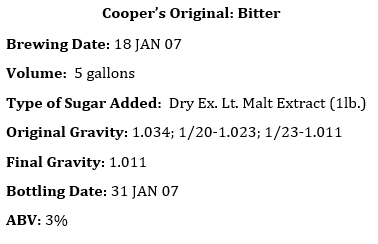
I was ecstatic when I unpacked my new homebrewing kit... A bucket with a lid, a carboy, a racking cane, some tubing, etc. along with an extract kit (Cooper's Original Series Bitter, which looks to have been replaced by "Real Ale") augmented with steeping grains, dry malt extract, and hops. I could not wait to get going! I think I brewed the very first weekend I was home...

I started like so many others, at that time at least, with a stove-top partial boil. I used a ceramic-coated steel canning pot. I steeped my grains until the water hit 165, then removed them and let them drain in a colander. I added my 3 lb. can of Cooper's liquid extract and 1 lb. of light dry extract and brought them to a boil. I followed the directions and added my hops when the homebrew shop owner's recipe said to do so. I put 2 gallons of filtered, cold water in the carboy and poured the hot wort through a colander and funnel into the bucket, then topped off with more filtered water. I added the Cooper's dry yeast sachet, and plopped the lid and airlock on the bucket.

I followed the instructions mechanically. I knew the basic process from reading The Complete Joy of Homebrewing (3x - remember?), but I had minimal understanding... Similar to when you begin cooking for the first time, it's more about the algorithm of the recipe than the process and how the ingredients fit together to make the final product. Plus, like any other process-oriented task, it takes going through it a time or two before the timing and flow feel right. Despite what Charlie Papazian says, I found it hard to "relax" avoid worrying, and I had no homebrew yet! (I don't even remember if I drank beer while brewing this one.)

I did take good brewing notes (the can of Cooper's extract came with a short data sheet in the instruction packet). After two days, I measured the gravity; two days later, it was stable, so I "racked to secondary for conditioning." Like most people 10 years ago, I conditioned my beer in secondary - in my case a glass carboy. After two weeks, I ended up with 5 gallons of (under-attenuated) bronze-colored ale, which I bottle conditioned in a combination of new 22 oz. and recycled 12 oz. bottles. I was so close, and yer I still had two weeks to wait!

By the time the bottles from my first brew were carbonated and ready, I already had two more batches under my belt. I chilled a few bottles in the refrigerator, but one bomber went into the freezer for the quick chill... When it came out of the freezer, the cap came off with a satisfying "pop-hiss." It poured beautiful and clear, almost amber, with a beautiful head and wonderful hop aroma. Casting back, it also smelled characteristically like a liquid extract beer... This was not, I have since learned, necessarily because it was an extract batch, but more a product of it being a partial boil extract batch.

My first beer, albeit less-than-perfect (under-attenuated, extract-y, etc.), was a success! My mother-in-law, who is not really a beer drinker, even liked it. I was excited at my success, and even more excited that I already had two more batches nearing completion. I became obsessed with homebrewing, reading all that I could find, messing around with recipe calculators and watching the effects of different ingredients and amounts on virtual beers, and brewing at least once each month. I gained a reputation with my friends... The guy that finally got me started homebrewing became a regular brewing partner (one year, we brewed over 300 gallons together), and he started coming to me for brewing advice!

Ten years have gone by quickly. My boys, who were first inhibitors to brewing, progressed on as helpers; they loved hanging around on brew day and helping me bottle (which was great, because I loathed bottling). Now they're old enough that they have a fairly thorough understanding of the science of brewing, and they like hanging out occasionally on brew day less out of admiration and youthful desire to be part of what Daddy is doing and more just to hang out for the company. It won't be long before we can brew together while sharing a couple of homebrews. I'm not brewing as much as I have at times in the past, but I'm no less passionate about homebrewing.

Cheers!

Wednesday, March 11, 2015

Time for a Brew Kettle Modification?


SS Brewtech Trub Dam
While reading a brewing magazine recently, I saw SS Brewtech's Trub Dam. I currently have a copper tube, perforated with holes and covered with stainless steel braid; it is prone to clogging with
My current kettle screen
trub and protein break... at the very least, it slows WAAAAAY
down towards the end of the draining process.

1" copper pipe, flattened/notched 3/4" copper coupling, 90° elbow
I sketched up a similar trub dam which used copper fittings. Some cutting, simple soldering - it was possible. I decided it was at least worth a try.

Materials:
1/2" x 1/2" threaded adapter
1/2" copper pipe (1")
1/2" copper 90° elbow
3/4" copper coupling
1/2" copper tube strap


  • I soldered the copper pipe section into the threaded adapter. This gets screwed directly to the threaded valve on the kettle. 
  • I had hoped to find some copper flashing for the main portion of the dam/diverter, but I could not source any locally. I got creative and cut the 3/4" copper coupling lengthwise, then bent it open and flattened it out; I notched it about 1/2" and bent that up for a soldering surface to connect to the 90° elbow.
  • I worked the 1/2" copper tube strap into a "C" shape to match the width of the flattened coupling. I filled the screw holes with solder, then soldered that 90° to the flattened coupling as the diverter on the dam. I trimmed the base to fit

1/2" copper tube strap, soldered base/90° elbow
base - showing uptake gap
1/2" copper tube strap, solder-filled


diverter/dam complete

I'm hoping that I can get the wort going in a "whirlpool" as I chill it, and use this new diverter/dam fitting to keep the trub and hop mass out of my wort as I drain it into the carboy...

Monday, March 2, 2015

Brew Day: Two Dry Stouts!

With Saint Patrick's Day a couple of short weeks away, I find myself without anything appropriate on tap! I always try to have something dark and roasty on - either a stout or a porter, o
r both! I am not the type who thinks of darker beers as winter seasonals... I can drink a porter anytime, and a dry stout functions just fine as a "lawnmower beer" for me.
Sláinte Mhaith - my dry stout

I have a standby (award winning) dry stout recipe that I brew at least 2-3 times per year. It is consistent and a pleaser for any fan of the style. I call it 'Sláinte Mhaith' (SLAHN-cha wa - Irish Gaelic for 'Good Health'). It is really just the recipe from Brewing Classic Styles (http://www.amazon.com/Brewing-Classic-Styles-Winning-Recipes/dp/0937381926) by Jamil Zainasheff (@mrmalty) and John Palmer with whatever uniqueness my system/process lends:
70% Maris Otter British Pale Malt
20% Flaked Barley
10% Roasted Barley
I use WY1098 British Ale as my yeast...

I have always loved stout - I was among the first people I knew to like Guinness (I will not admit how early). Like many brewers, I originally fell prey to the "more is better" thinking when formulating my stout recipes. When I sat down to write this blog entry, I looked back through my recipe binders and brew logs... There were TEN stout recipes (American and dry). Each was decent - I don't believe I ever made a terrible stout (I have made a few terrible beers though). But none of them was what I was looking for - thus the ten different recipes, none brewed a second time.

Then I listened to Jamil's Dry Stout  episode on The Jamil Show (http://thebrewingnetwork.com/shows/The-Jamil-Show) - the original one, not the Brewing with Style newer one... He talked about the simplicity of classic Dry Irish Stout. I brewed that recipe, which he later included in the book referenced above: it was exactly what I had been pursuing! I have been brewing that exclusively as my dry stout recipe ever since.

2015. The year is young, and I have been immersing myself in brewing media: Basic Brewing Radio/Video, the beer engineChop & Brew, Brewing Network... Was it time to brew a different stout? Should I put more than one stout on tap? An episode of Chop & Brew and an entry in the beer engine blog featured a Beamish-inspired dry stout - I had tried clones of Beamish in the past, but they had fallen short. This recipe, and the subsequent tasting on Chop & Brew, seemed compelling.

I talked through my ideas with my local brewery's tasting room manager (and former student), and he mentioned he had a nitro system that was not currently in use. What?! He offered it to me on loan! That iced it - I was going to brew both, and serve them both on nitrogen!

Brewed and ready for March 17th. No green beer here - only proper stout!

--------------------------------------------------------------------------
Slainte Mhaith
--------------------------------------------------------------------------

Category: Stout
                Subcategory: Dry Stout
                Recipe Type: All Grain
                 Batch Size: 5.5 gal
              Volume Boiled: 7 gal
            Mash Efficiency: 70 %
        Total Grain/Extract: 10.00 lbs
                 Total Hops: 2.0 oz

Ingredients
--------------------------------------------------------------------------
            7 lbs Maris Otter Pale
            1 lbs Black Roasted Barley
            2 lbs Barley (Pregelatinized Flakes)
              **2 oz East Kent Goldings (Whole, 5.00 %AA) boiled 60 minutes.
           Yeast: Wyeast 1028 London Ale

Notes
--------------------------------------------------------------------------
Mash @ 152°

Vital Statistics
--------------------------------------------------------------------------
 Original Gravity: 1.044
 Terminal Gravity: 1.009
            Color: 27.47 SRM
       Bitterness: 41.8 IBU
Alcohol (%volume): 4.5 %


** I actually shifted 10% of the hop bill to 10 minutes to match the Beamish-inspired recipe (for analoous comparison purposes)

--------------------------------------------------------------------------
Squeamish
--------------------------------------------------------------------------

                   Category: Stout
                Subcategory: Dry Stout
                Recipe Type: All Grain
                 Batch Size: 5.5 gal
              Volume Boiled: 6.5 gal
            Mash Efficiency: 72 %
        Total Grain/Extract: 9.25 lbs
                 Total Hops: 1.9 oz

Ingredients
--------------------------------------------------------------------------
            7 lbs Maris Otter Pale
            1 lbs Malted Wheat
         0.75 lbs Black Roasted Barley
          0.5 lbs American Chocolate Malt
           0.6 oz East Kent Goldings (Pellets, 5.00 %AA) boiled 60 minutes.
           0.4 oz Perle (Whole, 8.25 %AA) boiled 60 minutes.
           0.5 oz Hallertau (Whole, 4.50 %AA) boiled 60 minutes.
           0.2 oz East Kent Goldings (Pellets, 5.00 %AA) boiled 10 minutes.
           0.1 oz Perle (Whole, 8.25 %AA) boiled 10 minutes.
          0.15 oz Hallertau (Whole, 4.50 %AA) boiled 10 minutes.
           Yeast: Wyeast 1098 British Ale

Notes
--------------------------------------------------------------------------
Mash @ 152°

Vital Statistics
--------------------------------------------------------------------------
 Original Gravity: 1.042
 Terminal Gravity: 1.008
            Color: 28.44 SRM
       Bitterness: 39.1 IBU
Alcohol (%volume): 4.3 %

Saturday, April 23, 2011

The Pride of Sharing


I enjoy cooking. I enjoy making beer. They are both similar in process and creativity. But they are similar in another way as well...

If I am alone, I am unlikely to cook anything fancy. In fact, a sandwich or something simple and utilitarian is my most likely "dining alone" meal. Why? I'm probably not worth the effort. Seriously, for me a big part of the reward of cooking a good meal is the enjoyment of those who are eating it. I love it when people like my cooking. It makes me feel good. Unfortunately, a longer commute has relegated me to mostly weekend cooking and an occasional slow cooker meal during the week...

Making beer provides me with a similar experience (although I have absolutely no problem enjoying beer alone!). I love to share and talk about beer - it is fun and enjoyable. But it is even more rewarding when it is beer that I made.

It is funny, but the same people who have grown to expect great cooking from me are still surprised by my homebrew. I think that beer is one of those mass-produced commodities from which most Americans have become detached in terms of production. Like french fries - my mom used to make homemade french fries, but now people are shocked and amazed if you made them from scratch. Pretty soon, bread will be the same way.

With beer, there is some notion of magic or mystery since most people don't understand how it is made. I think the collapse and consolidation of the brewing industry in the latter part of the 20th century helped foster this notion. Without local small breweries, beer was produced off on the outskirts of society, arriving magically on the shelves of grocery store coolers. The brewing process was lost in the folds of imagination.

I think that is changing, given the number of local breweries springing up around the country. In Kitsap County alone (a rural/suburban county on the western shores of Puget Sound, a ferry ride away from Seattle), we now have at least five craft brewers - and three of them opened within the last two years. So, given that people (in places like Western Washington, Oregon, and California at least) have access to fresh, local beer, why are folks still surprised by homebrew?

I don't think they are surprised by the variety, freshness or quality anymore. I think they are still surprised because they don't understand the process. I love it when the conversation turns from "Really - you made this?" to "What kinds of beer do you make?" then finally to "How do you make it?". That's the money question. Demystifying the process.

I am fortunate, because nobody has begun to take my homebrew for granted the way they do my cooking.

Brewing is rewarding for me, of course. I mean, I get to make whatever kind of beer I want. I control the process from ingredients and recipe, all the way to the finished product. And it is beer - five gallons at a time! But as rewarding as it is for me myself, it is all the more rewarding when shared with friends.

Monday, December 6, 2010

Feast or Famine... (AKA November Redux)

I think my last post was in June. Even before that, the posts were intermittent at best! There was not a ton to report as far as my usual topics go, though. Is it too early for New Year's Resolutions???

The looming Holiday Season jump-started my brewing again. Most tasks may be "like riding a bike" in terms of never truly forgetting how to do them, but brewing, like driving a manual transmission, is one best served by regular practice! It is not rocket science, but there are a lot of steps. The beer is better when things go smoothly.

Since I am a "yeast starter" guy, I need to start my timeline a couple days early in order to brew. I'm no stranger to brewing through the night after family stuff is done (hence the name of this blog), but planning is still necessary. Since I had a list beers I was planning on brewing in the late summer and early fall, most of my yeast was getting tired viability-wise. This added a few more days to the brewing timeline, because I had to step-up my starters.

Nevertheless - I finally got my Dunkel Weiss going a few weeks ago... It was my first Bavarian-style weiss beer, having only brewed an American Raspberry Wheat (for my wife) previously. I have heard all the stories about the vigor of this yeast (the Weihenstephan strain - WY3068), but was still not prepared! This yeast was relatively fresh, so I did my usual 2L starter.

Geyser is probably not the appropriate term, since it did not hit the ceiling... But I came home from work to find the foil off the carboy, and a steady flow of krausen flowing down the entire circumference of the carboy. I am glad that the carboy was in a milk crate and on a towel (and likewise glad that I found this before my wife)!

I am no rookie when it comes to blow-off mishaps. In fact, my wife has called me at work and even threatened to cut off my brewing of ales (fermenting in the house) as a result of vigorous fermentation accidents. Fearing the loss of hobby privileges, I have adapted my techniques to try to avoid these yeast-caused problems...

When I ferment in a 5-gallon vessel, I always use an appropriately-sized blow-off tube which flows into container of ample volume (2L minimum, emptied before I go to work!). Preferably, I ferment in 6-gallon vessels, and never put more than 5.5-gallons of beer into it. It has been quite a while since I had more than a couple tablespoonfuls of yeast krausen escape containment, which may be why this massive flow was such a surprise (FYI - keep your dog away if you expect that your yeast is making a break for it! I had to drag my lab away from licking up the expelled yeast!). I put about 5.25 gallons into the 6-gallon fermenter.

Having not been caught by my wife, I quickly changed out the towel, and took the vigorous yeast activity as a good sign (while at the same time dreading the future carboy-cleaning task). I did a little triage, and the fermentation was back on track. Then came the Thanksgiving-week storm... If you don't live in the Pacific Northwest, you might have missed it - but we got 4" of snow in the Puget Sound region, accompanied by high winds and power outages.

I pretended like I was concerned for the comfort of my family (OK, I was a bit concerned) as I kept the wood stove gong 24-7. I was worried about my 4 yeast starters and my Dunkel Weiss, and needed to maintain a suitable ambient temperature in the face of no power and sub-freezing outdoor temperatures! I dutifully kept logs on the fire, and occasionally sneaked a peak at the LCD carboy thermometers, aiming to keep their temps above 60° at least. I think I managed OK.

I mentioned the Holiday Season as a motivational factor. Since the very first year I homebrewed, I have given beer as gifts. At this point, I think that my friends and co-workers would be disappointed by anything other than beer (this is quite a compliment). And at our National Guard Holiday Party, it is a foregone conclusion that I'll provide baskets of homebrew for the family support auction. If you are a homebrewer, you know what I'm talking about - the list of people who want your beer grows...

By my reckoning, demand was going to exceed supply... I took stock of on-hand supplies and proven recipes. Next up: a partial-mash ESB that has become a bit of a stand-by! The partial mash was carried out in a 2-gal beverage cooler, and added to a the kettle with some DME for a full-wort boil. I love this recipe (based on somebody's take on Fuller's ESB - but in my mind, not really a clone), and like to brew it 3-4 times a year. It has also become one of the beers that I like to use to check out different yeasts... This time around I went with NW Ale (WY1332 - believed to be from Hale's in Seattle). At this point, it is probably very close to being done...

On the Saturday after Thanksgiving, I loaded up the wagon with brewing equipment and supplies for the trek to Seattle for an annual memorial brew day. I lost the best friend (a homebrewer) I ever had - the closest thing I had to a brother - on the 23rd of November, 2003 in Iraq; a family of lifelong friends lost their homebrewer almost two years ago on Superbowl Sunday (his birthday is in November)... We decided to make a commemorative tradition on Thanksgiving Weekend. This was our second year (last year we brewed a delicious Winter Warmer and a Robust Porter)...

Ferry traffic was crazy, and I arrived late. But things went fairly smooth for only my second brew session in months! I brewed a Rye Pale Ale, based on the Terrapin Rye clone on the Can You Brew It show on the Brewing Network (http://www.thebrewingnetwork.com/shows/597); Ben brewed an Amber Ale from Brewing Classic Styles. We drank the last bottles of each of our beers from last year, video skyped with our missing brew partner who's teaching in Viet Nam, and enjoyed the good company of family.

I missed the mark this past weekend... Several of my beers were not yet ready, and I needed to fill two raffle baskets. I have been lagering a batch of Classic American Pilsener for my Mom - but at least 24 bottles of it absolutely needed to find its way to her this time around (this is a long and entertaining story in itself). In my keezer, I still had a few gallons of beer left from late-summer brewing: a little over a gallon of Düsseldorf Alt brewed for a friend's retirement and a little over a gallon of an Imperial Rye IPA (a modification of Denny' Rye IPA). I counter-pressured this into bottles. I also had a few bottles of Pumpkin Ale (an attempt at an Elysian Night Owl clone, tasted and preferred on the Can You Brew It show - to the best of my knowledge, the only non-show homebrew tasted and discussed on the show) left from last winter. So, the baskets looked as follows:
  • 2x 22oz Dunkel Weiss
  • 2x 12oz Pumpkin Ale
  • 1x 12oz Classic American Pilsener
  • 1x 22oz Düsseldorf Alt
  • 1x 22oz Imperial Rye IPA
After recovering from the power outage, I had fallen a bit behind, so I pulled some near all-nighters getting caught up leading into this weekend... Including a marathon bottling session where I bottled over 12 gallons of beer over Saturday night in order to have the beer baskets ready for Sunday. Maybe my timelines need a bit of adjustment?

I will definitely be in good shape for the rest of my bottled gifts leading into the holidays... I've already got the remainder of my bottled Dunkel Weiss and CAP, and should be adding the ESB and Rye Pale Ale shortly. I've got several recipes on deck, including a big batch of Pale Ale for a lautering experiment proposed by BYO magazine and Basic Brewing Radio. I'm torn between ending the year in a brewing flourish, still coming well short of my 100-gallon goal, or saving most of my brewing plans until after the New Year in order to get a jump on 2011's goal!

Sunday, February 14, 2010

MMX Reflections...


I am off to a bit of a slow start on both blogging and brewing this year... I finally decided to move my blog. I started the old blog at the start of my deployment to Afghanistan, and underwent several evolutionary changes in the time since then. This new blog will be much more focused on my hobbies and how I spend my freetime - the name (which means middle of the night in Latin) reflects this. If you know me, you understand the name...

About three years ago, I brewed my very first batch of beer. Wow. I fully blame my buddy Robert for getting me into this hobby - here is how it started:

At the end of August 2006 in Afghanistan, I decided that I would go out with one of our teams - Robert's team. This was going to be different from other times I had gone out on "command visits" because I was going to replace one of the operators on Robert's team. Robert was the team leader, and I'm sure he was probably less than comfortable with having his First Sergeant join him on an extended operation - nothing like having senior leadership meddling in your day-to-day affairs! Meddling, however, was not my intention; it was Rob's team, and I was just a strap-hanger that was filling a shift on the team.

After only two or three days into what ended up being about thirty days, it was fully evident that Rob and I were definitely among the geezers on hill. Most of the younger guys spent their downtime talking about things like "hot chicks", fast cars, and how they were going to spend all of their money when they got home. We had not even seen most of the movies or TV shows these guys were talking about, and at nearly 40, our interests were significantly different.

I'm not sure who mentioned it first, but one of us brought up how much we missed good beer. As the conversation continued, Robert lamented the fact that he had a batch of unbottled homebrew sitting in a carboy back at his apartment, and how it would have spent over a year in the carboy by the time he got back to bottle it. I didn't really even know what a carboy was, but had been interested in getting into homebrewing for a long time.

Robert was full of great info, and most of our non-mission-related conversation for the rest of the operation revolved around beer and homebrewing. He told me that the best starting point was Charlie Papazian's The New Complete Joy of Homebrewing. He said that it was sure to get me started off on the right foot, and was an entertaining read to boot! As Rob described it, it sounded akin to Zen and the Art of Motorcycle Maintenance, philosophy and practical information rolled into one.

After thirty days without a shower or a hot meal, one of the first things I did was get online and order the book, along with The Homebrewer's Companion, also by Papazian (OK, the real order of events upon arriving back on base was more like this: 1) check back in with my commander; 2) attend our battalion's weekly command & staff meeting; 3) hot dinner - KBR never tasted so good; 4) hot shower and clean uniform; 5) amazon.com to order the book). After so much thinking about beer, I broke down and drank my first non-acloholic beer – Bitburger Drive – not great, but OK when it was ice cold, by the way.


Once Rob's team went back out, I had nobody to talk to about beer... It was going to be at least another week before my amazon.com order... I was going crazy doing internet searches... Then I discovered a couple of podcasts: Basic Brewing Radio and the Brewing Network. I downloaded everything I could, and spent a lot of time listening. When the books arrived, I read them over and over – three times before I got home.


My wife and I talked about delaying Christmas until I returned sometime in January 2007. When the topic about my gift came up, I took advantage and told her I wanted a homebrew starter kit. My wife must really love me, because she knows how I get about my hobbies (she often says I don't have hobbies – I have obsessions), but she still bought me that setup and my first beer kit. The shop owner (Bill at Olympic Brewing Supplies in Bremerton, WA) asked her what kind of beer I liked, then set me up with a decent all-extract Cooper's English Bitter kit (one can of Cooper's, supplemented with additional malt extract, and dry yeast).


I brewed it at the start of February, and when I drank the first bottle towards the end of the month, I thought it was the best beer I had ever tasted! It was probably pretty good, but we all know how our opinions are colored by our amazement on our first few batches. I followed up with a stout, modified from Papazian's Toad Spit Stout, which I dubbed “Dark Horse”, and ready in time for St. Patrick's Day. This one got rave reviews from more than just my family, and I was off and running!


I was still addicted to surfing the internet for all things beer and homebrew, and was interested in brewing software... I downloaded many trial versions and tried them all out. I discovered Beer Tools, which offered a free online (simplified) recipe formulator. I used that to help me modify a few recipes from Papazian's books and from the homebrew shop. Then I ordered Beer Tools Pro, which was available for Mac, and I upgraded to a gold membership on their website...


By the time June rolled around, I had already brewed six batches, and was ready to move beyond extract batches with steeping grains. I think I ended up with 11 or 12 batches (at 5 gallons each) that first year, and I learned quite a bit about recipes and basic processes. That was a big year for me, and many of my friends had begun to ask me about my brewing, perhaps in part to get more homebrew!


As I look back over the past three years, I chuckle a bit about how much I thought I had learned and how much I though I knew at the end of that first year. Two of my biggest learning experiences actually stemmed from failures: one a probable sanitation problem that resulted in iodiney-gushers (bummer – my first all-grain batch!), and the other a drastic underpitch on my big holiday beer (anybody like flat banana beer?)... It is true that I did progress quite a bit in my brewing, but I had yet to make any changes that truly elevated my brewing and got me brewing consistently great beer.


Since then, I branched out and did much more reading. I listened to many more podcast episodes – the ones that got me started and kept me sane in Afghanistan, and some new ones as well. Brew Your Own and Zymurgy magazines were also full of great info. James Spencer of Basic Brewing Radio really got my head in the game, so to speak. But it was the Brewing Network content featuring Jamil Zainasheff that really helped me make better beer.


In my second year of brewing, I got a bigger brew pot and a propane burner so that I could do full-wort boils and I began pitching yeast starters. These two simple and relatively inexpensive steps improved my brewing tenfold. I had much greater control over my beer's flavor profiles, and my fermentations kicked off quickly and reliably, and progressed predictably. What a huge difference this made!


Thanks to a great article in BYO by Chris Colby, and info in Basic Brewing Radio and Video, I got set up better for mini-mashing (partial mash technique). Before I was trying to mash grains in my brewpot suing the oven for temperature control; I switched over to countertop partial mashing using a 2 gallon beverage cooler, and I gained a much better understanding of mashing grains, starch conversion, and individual grain contributions to my finished beers. My beers began winning medals and ribbons in competitions at this point. I also made the move to some all-grain brewing in a 5 gallon beverage cooler I had in my garage. Robert, the buddy who had gotten me started, began coming over at least once a month to brew... I also began kegging and built a kegerator from a converted chest freezer. My son's Kindergarten teacher informed me that he had shared that the most fun thing he did over a long weekend was helping his dad and friend Robert bottle their beer (my boys have a thorough understanding of the process and biology of beer, despite being 5 & 7 years old!). Things were really rolling!


Year three saw me continue striving to become a better brewer... In my National Guard unit, my soldiers were relying on me for a regular supply of good beer, including kegs to mark special occasions. My holiday beer baskets sell more tickets than any other raffle item at our annual holiday drill! Robert got roped into another deployment, though, and my feverish pace slowed quite a bit. While he was gone, I began getting other friends involved in homebrewing – in my National Guard unit, there are 5 or 6 guys that are brewing regularly now after an instructional brew day with me.


I still have averaged just under 100 gallons (not including root beer that I make with my kids or hard cider) in my first three years brewing. While I have come a long way, and enjoy teaching other people what I know, I realize that there is still a lot more that I don't know about brewing than what I actually know. I am hoping to get a few more people into the hobby this year, and I am hoping to break the 100-gallon mark for the the first time. Now that Rob is back, I am hoping to brew with him more regularly again.


So far, I've only brewed 12 gallons in 2010 (one Rye-PA and one American IPA as part of an experiment). I have those two batches, plus a dark lager that I started in December, to keg or bottle this weekend. And I have at least two batches that I should brew (one dry stout as a moving/housewarming gift, and one hybrid classic/American pilsner using SF lager yeast for a picnic in March)... And St. Patrick's Day is coming up! I guess I had better stop thinking about brewing, and get to work!